


A newly released macroeconomic report from the Organisation for Economic Co-operation and Development (OECD) has officially lowered its global economic growth forecast for 2026 to 2.8 percent, citing localized energy blockades and prolonged supply chain disruptions in the Middle East. The updated Economic Outlook report highlights that while the global market entered the year with stronger-than-anticipated baseline resilience, the continuous friction around the Strait of Hormuz has severely choked off standard maritime transport and escalated commercial freight insurance rates. Economists warn that if these crucial shipping corridors remain compromised into the third quarter, a “prolonged disruption scenario” could trigger severe shortages in raw industrial goods and agricultural commodities, dragging global output down to a stagnant 2.1 percent. This persistent structural bottleneck has already driven crude oil futures closer to the triple-digit mark, applying immediate pressure on net-importing western nations and forcing international policymakers to adjust their long-term domestic fiscal targets. Despite these broad headwinds, the OECD data revealed stark divergence across regional performance, keeping the United States GDP growth steady at 2.0 percent while slightly elevating China’s outlook to 4.5 percent and India’s to 6.3 percent. However, the overarching risk remains that sticky, energy-driven headline inflation could spike by an additional 1.3 percentage points globally over the next eighteen months, potentially forcing central banks to hike benchmark policy rates by another 50 to 75 basis points. For industrialized economies already leaning on fragile domestic demand, these elevated borrowing costs threaten to compound corporate debt liabilities and sharply stall private sector infrastructure investments. As government delegates gather to deliberate on global trade recovery frameworks, the report emphasizes that structural peace agreements and the immediate stabilization of global supply lanes are the absolute prerequisites for avoiding a broader multi-nation recession. Ultimately, this economic recalibration demonstrates how deeply tied domestic consumer pricing remains to localized geopolitical Flashpoints, illustrating that sustainable global growth cannot occur without maritime security and predictable energy flows.
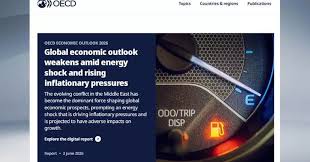
Global Economic Slowdown: OECD Dowers 2026 Growth Projections to 2.8% Amid Middle East Energy Disrupted

You May Also Like

More From Author


Global Corporate Realignment: Indian IT Giants Scale Up Microsoft Copilot Deployments to 300,000 Employees