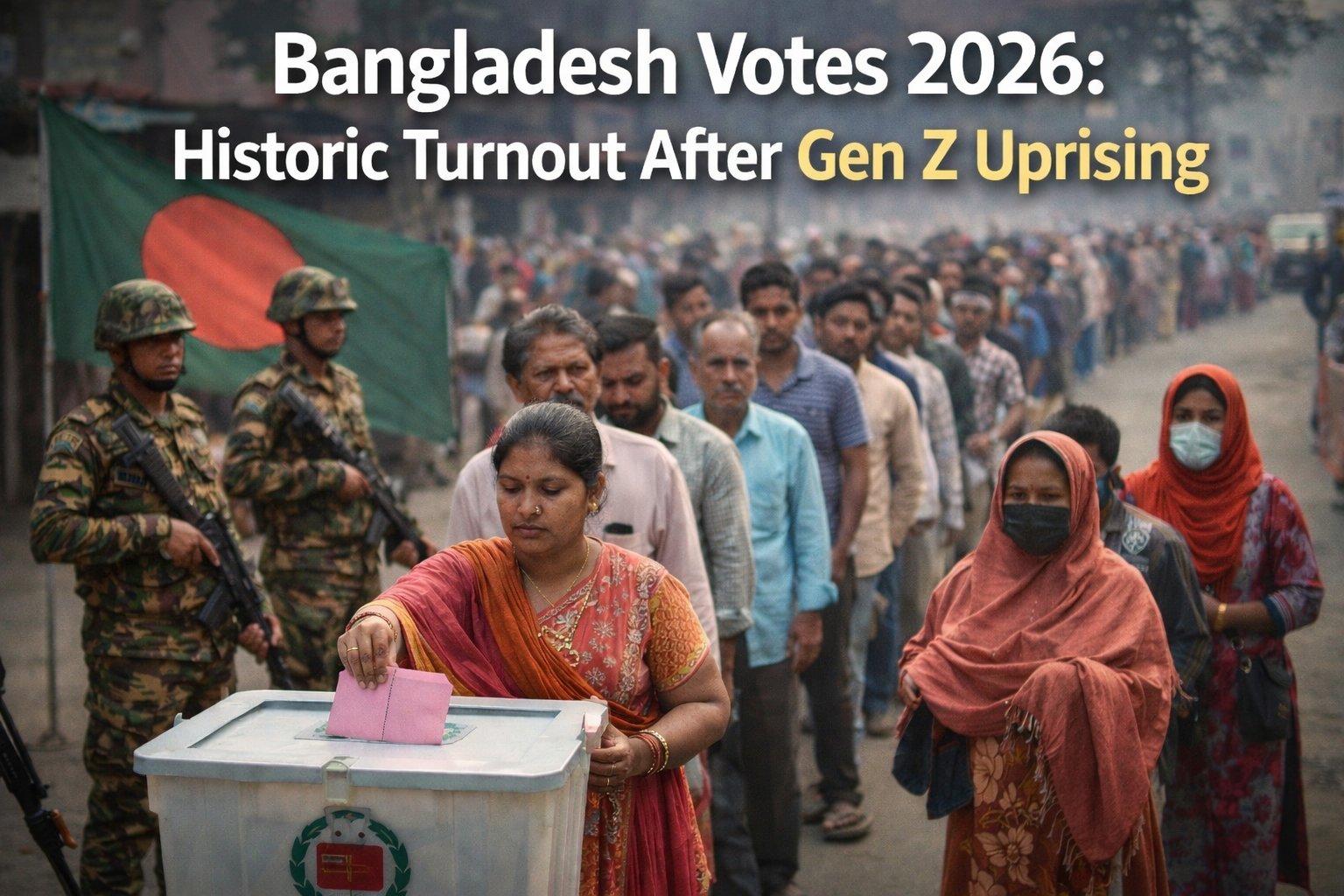
Bangladeshis voted on February 12, 2026, in a historic general election—the first since the 2024 uprising led by young voters under 30, known as the Gen Z revolution. The election sees political parties, long suppressed under Sheikh Hasina’s rule, return to the political arena with new leadership and coalitions.
Strong Voter Participation Amid Security Measures
With around 128 million eligible voters, turnout reached 32.88% by noon at roughly three-fourths of the country’s 42,651 polling stations, according to Akhtar Ahmed, senior secretary of the Election Commission. Over 300,000 soldiers and police were deployed nationwide, while UN experts warned of rising disinformation, threats, and attacks targeting young first-time voters.
In the capital Dhaka, citizens queued early outside polling booths. Voters like Mohammed Jobair Hossain, 39, expressed excitement, saying it was the first free vote in 17 years. First-time voter Shithi Goswami, 21, said she hoped the election would bring positive change after years of political turmoil.
Main Contestants and Political Context
Prime ministerial candidate Tarique Rahman, 60, leads the Bangladesh Nationalist Party (BNP) and remains confident about regaining power. He faces competition from a coalition led by Jamaat-i-Islami, whose leader Shafiqur Rahman has campaigned on anti-corruption and justice-focused platforms. Opinion polls suggest a tight race, though BNP is generally ahead.
Interim leader Muhammad Yunus, 85, who will step down after the election, emphasized that the vote marks a new chapter for Bangladesh, stating it has “ended the nightmare and begun a new dream.”
Election Oversight and Challenges
The Election Commission confirmed voting is proceeding smoothly, despite minor disruptions and widespread social media misinformation. Citizens are also voting on a referendum for democratic reforms, including prime-ministerial term limits, a new upper house, stronger presidential powers, and judicial independence.
Economic and Regional Implications
The next government will inherit a fragile economy, heavily reliant on the garment industry, and will manage sensitive relations with India. Tarique Rahman highlighted restoring security and stability as a top priority while acknowledging the significant challenges ahead.
President Asif Ali Zardari extended wishes for a peaceful and democratic process, expressing hope that the election would strengthen democracy and stability in Bangladesh.