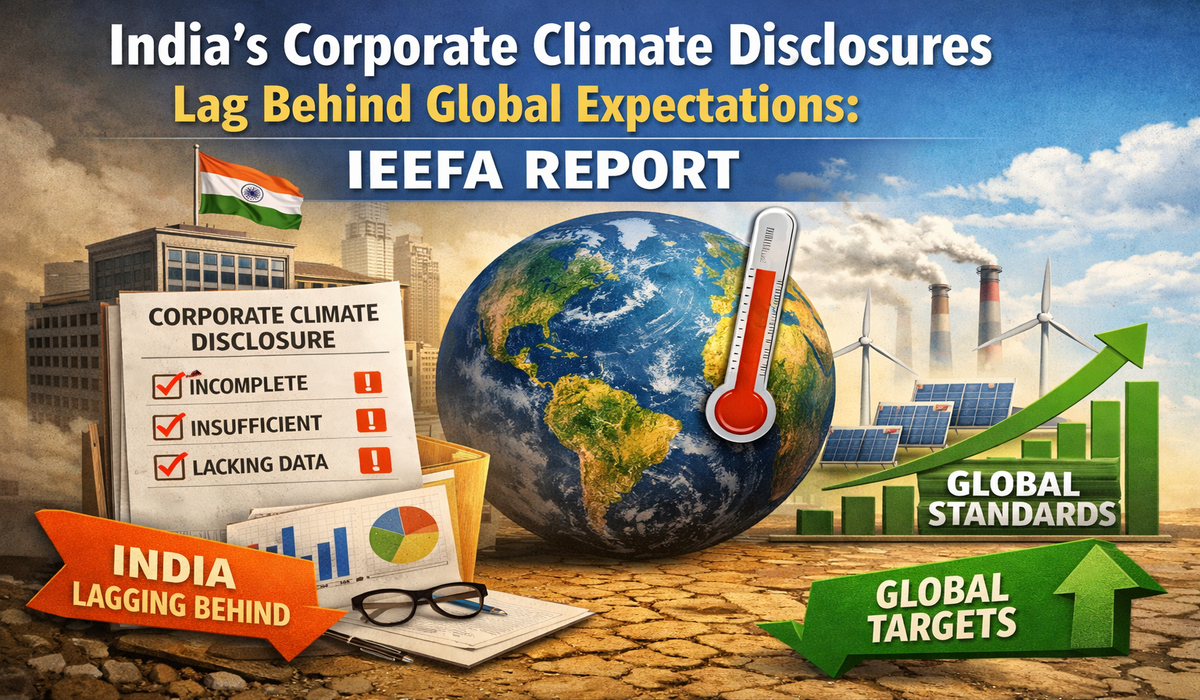
India’s corporate climate disclosure framework may fall short of global investor expectations, particularly as climate transition planning becomes a key factor in capital allocation decisions, according to a new analysis by the Institute for Energy Economics and Financial Analysis (IEEFA).
The report highlights gaps in India’s Business Responsibility and Sustainability Reporting (BRSR) when compared with the International Sustainability Standards Board (ISSB) S2 climate standard, noting that while BRSR emphasizes broader environmental, social, and governance (ESG) metrics, it lacks several crucial elements needed for credible climate transition planning.
Key Gaps in India’s BRSR Climate Disclosures
According to IEEFA, the BRSR framework falls short in several areas critical to investors:
-
Scenario analysis: No mandatory requirement to evaluate multiple climate scenarios.
-
Linkages between greenhouse gas targets and transition strategies: Companies often fail to outline how targets will be achieved.
-
Climate-specific governance disclosures: Limited information on board and management oversight of climate risk.
-
Funding strategies for transition plans: Financial planning for climate transition is often unclear or missing.
By contrast, ISSB S2 offers more detailed guidance, requiring companies to disclose transition plans, financial impacts of climate risks and opportunities, and results from scenario analysis, making it more useful for investors evaluating long-term resilience.
BRSR Strengths and Limitations
While BRSR excels in social indicators, providing measurable metrics for community engagement, workforce well-being, and social responsibility, it underrepresents climate-related dependencies:
-
Supply chain risks: Exposure to suppliers vulnerable to climate impacts.
-
Customer transition risks: Implications for clients adapting to low-carbon solutions.
-
Workforce transition risks: Preparedness of employees for shifts in a climate-aligned economy.
As a result, investors may find BRSR disclosures insufficient for assessing climate transition risks, which could affect capital allocation and investment decisions.
Implications for Investors and Companies
IEEFA’s analysis underscores that India’s current disclosure framework, though socially robust, is not fully aligned with global climate reporting standards. Companies seeking international investment may need to enhance climate-related governance, risk assessment, and scenario planning to meet evolving investor expectations.
In the coming years, aligning BRSR with international best practices could improve transparency, investor confidence, and India’s global ESG standing, ensuring that climate disclosures effectively support sustainable corporate growth.